 Options Wheel Trader
Some of the Research Behind the Options Scanner Weighted-Ranking Presets
April 21, 2026
Introduction
The Options Scanner in OptionsWheelTrader is a great tool for traders to identify CSPs and CCs based on their criteria. It provides a weighted ranking of the possible trades so that you can see how they best align with your requirements.
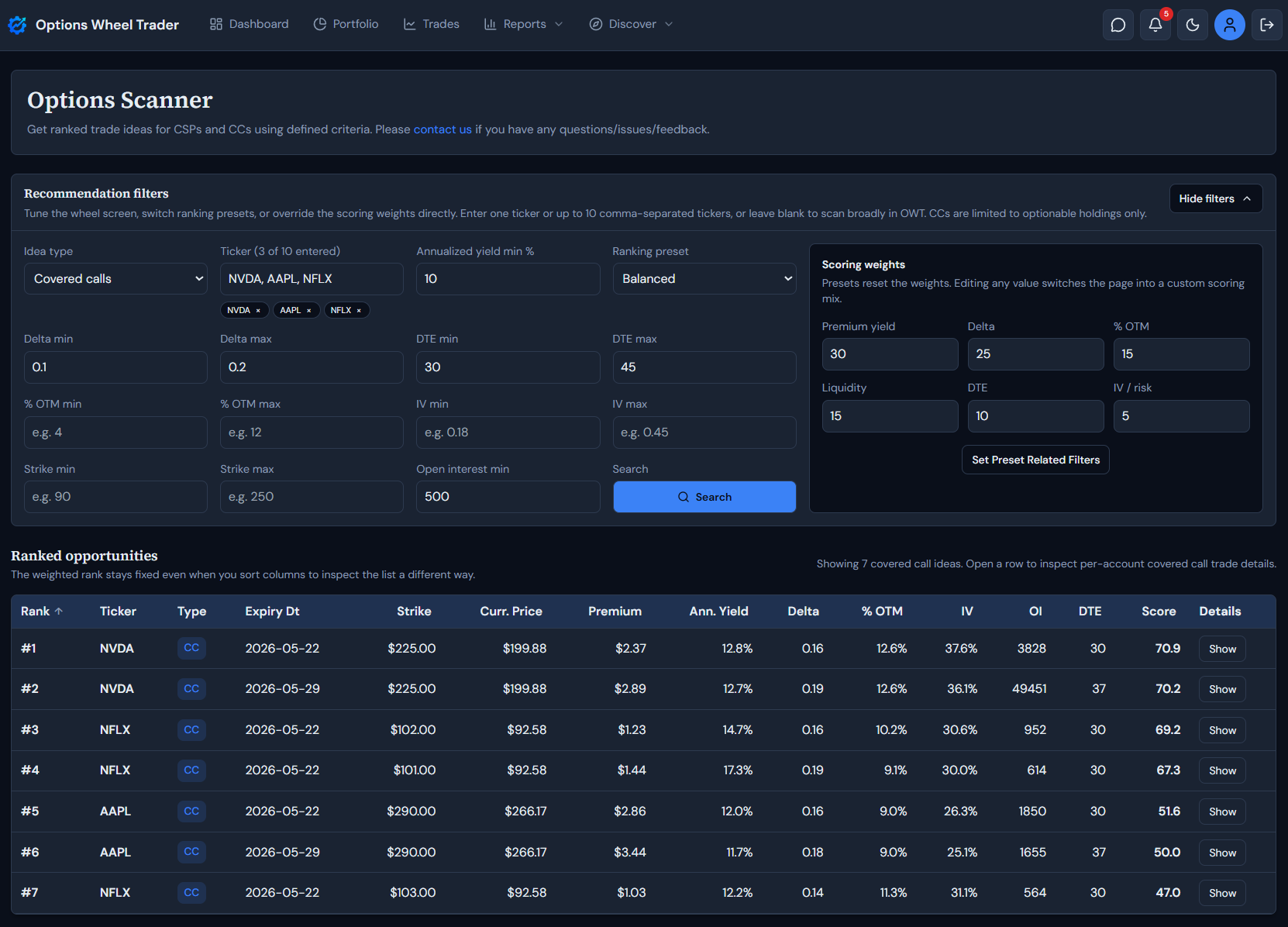
In this guide, we break down how the weighted-ranking presets were defined and the research behind them. You can always choose Custom and set your own weights as well.
Before we begin - Underlying Selection
Perhaps the most important step in the wheel strategy is the selection of the underlying for any options trade. You should only sell on stocks you are willing to own / sell at that strike.
What are the ranking presets?
You can choose one of three scoring presets:
- Yield-focused
- Balanced
- Safety-first
You can also switch to custom and directly set your scoring weights for:
- Premium yield
- Delta
- % OTM
- Liquidity
- DTE
- IV / risk
This is useful because two traders can look at the same option chain and want different things. The scanner lets you codify your preferences instead of re-deciding them manually every time.
How the preset variables were set
We researched high confidence sources across the web and came up with the following information:
-
Liquidity: effectively a hard gate, not just another score input. Tight spreads and solid volume/open interest come before yield-chasing. The strongest explicit numeric rule we found was Schwab’s: many traders look for bid/ask spreads <= 10% of the ask price. Role: primary.
-
Delta: the most commonly used strike-selection proxy because it maps to assignment probability. Schwab explicitly cites 0.30-0.40 delta for covered calls when the goal is income with a 60-70% theoretical chance of expiring OTM. For wheel traders leaning safer, ~0.20-0.30 delta is the common lower-risk extension; yield-focused traders often tolerate ~0.30-0.40. Role: primary.
-
Percent OTM: widely used descriptively, but the stronger sources usually express the decision through delta/probability, not fixed OTM percentages. Consensus is essentially: farther OTM = less premium, lower assignment odds, but no strong universal % target. Role: secondary, mostly redundant with delta.
-
DTE: strong consensus around 30-45 DTE as the center of gravity for short premium. Schwab says many covered-call sellers focus on 20-50 DTE; tastylive’s research centers on 45 DTE as the baseline “inflection point.” tastylive also suggests ~30 DTE when IVR is high (>30) and ~60 DTE when IVR is low (<30). Role: primary.
-
Implied volatility / risk: elevated IV is generally desirable for selling premium, but sources repeatedly warn not to treat high IV as “free yield.” High IV can reflect event risk or deteriorating underlying quality. Best practice is to prefer elevated but non-pathological IV / IV rank, especially outside earnings/event landmines. Role: primary.
-
Premium yield: weakest consensus on fixed numeric targets. The clear consensus is do not optimize this first. High premium often comes from strikes that are too close to the money, too much IV/event risk, or weak underlying quality. Treat yield as a reward check after liquidity, strike probability, DTE, and risk pass. Role: secondary.
How about the filter values?
We show you some hints about what default values you should use, but you get to set them based on your needs. That said, the weights only work well if the filter defaults are sensible. In particular, pay attention to the following filters:
- Minimum open interest
- DTE range
- IV range
- Delta range by side (put vs call)
The ticker filter supports up to 10 comma-separated symbols. Duplicate symbols are automatically removed, and if any invalid/non-eligible symbols are entered they are surfaced in scanner warnings while valid symbols continue processing.
We have added a button under the scoring weights whose label matches your ranking preset, for example Set Yield-focused Preset Related filters, Set Balanced Preset Related filters, or Set Safety-first Preset Related filters. Use it to apply our recommended filter values for that preset.
Ready to Try the Options Scanner?
Stop hunting through chains manually. Get started with OptionsWheelTrader for free and start scanning for wheel-friendly opportunities in minutes.
Legal Disclaimer
The Options Scanner and all related content are provided for informational and educational purposes only and do not constitute financial, investment, tax, or legal advice. Nothing in this article or in the product should be interpreted as a personalized recommendation to buy, sell, or hold any security or options contract.
Options trading involves substantial risk and is not suitable for all investors. You can lose money, including the full amount invested in a position, and outcomes can vary based on liquidity, volatility, assignment risk, and execution quality.
Scanner rankings are model-based outputs derived from user-selected filters and scoring weights. Rankings do not guarantee profitability, trade quality, or future performance.
Market data may be delayed, incomplete, or unavailable at times. Always confirm live prices, spreads, contract details, and account eligibility with your broker before entering any trade.
Past performance is not indicative of future results. OptionsWheelTrader is not a broker-dealer, does not execute trades, and does not provide individualized investment advice.
Review our Terms, Privacy Policy, and consult a qualified financial professional before trading options.